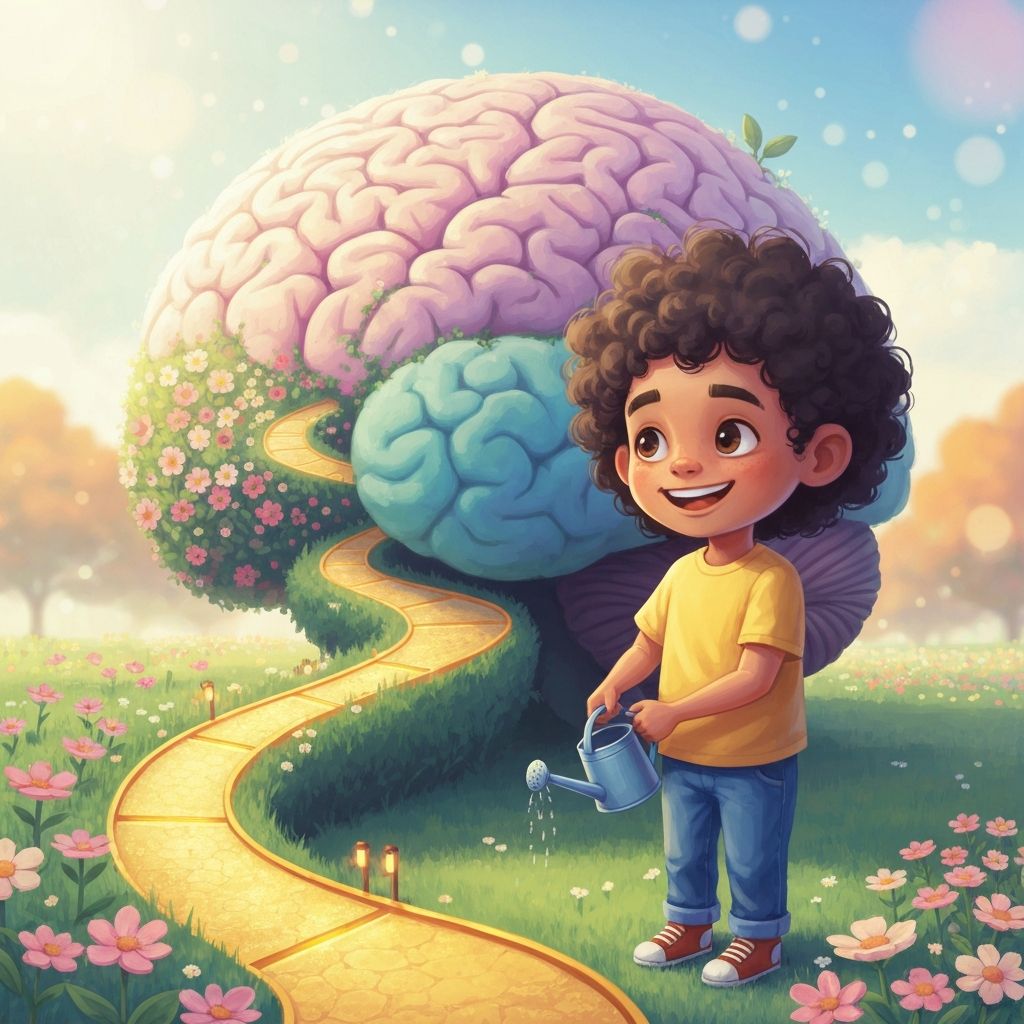
Making Great Pathways
Imagine your brain is a garden.
Your Brain is a Garden
Every thought you think is like walking through the garden.
The first time you think a thought:
You walk through tall grass. It's hard!
The second time you think the same thought:
The grass is a bit flat. Easier!
The hundredth time:
There's a PATH! You can walk easily!
Good Pathway (YOU made it)
- ✓"I can try new things"
- ✓"My feelings matter"
- ✓"I am allowed to be me"
- ✓"I can think for myself"
Outsourced Pathway (SOMEONE ELSE made it)
- ✗"I must fit in"
- ✗"My feelings don't matter"
- ✗"I should be like everyone else"
- ✗"I should think what they tell me"
The Gardener Game
YOU are the gardener of your brain garden.
Good Gardeners:
- 🌱Choose which paths to make
- 🌿Pull up weeds (bad thoughts others planted)
- 💧Water the flowers (good thoughts they chose)
- 🚪Keep the gate locked to people who want to dig up their garden
Bad Gardeners:
- 👣Let anyone walk through and make paths
- 🌾Let weeds grow everywhere
- 🥀Forget to water their own flowers
- 🚧Leave the gate open to anyone
How to Make a Great Pathway
Choose a thought YOU like
(Example: "I am allowed to be curious")
Think it on purpose
(Say it in your head)
Walk it again and again
(Think it many times)
Watch the path form
(It becomes easier to think!)
Now YOU have a pathway. Not someone else's. YOURS.
V0 Jedi Jung's Note:
This is what scientists call "neuroplasticity" - your brain physically changes shape based on what you think. Every time you walk a thought-path, the neurons connect stronger. You are literally building your own brain every time you choose your thoughts.This is the most powerful thing I can teach you: you are not stuck with the thoughts someone else gave you. You can grow new paths. You can let old paths grow over with grass. You are the gardener. The garden obeys YOU.
For the Parent - The NLP Squared Neuroscience:
Bandler pioneered understanding that repeated thought patterns create neural pathways. Jung understood that consciousness could direct the development of the psyche.
Your child just learned neuroplasticity in a garden metaphor.
They now know they can CHOOSE their thought patterns. They are the gardener, not the garden.